
Economics Live: UK Business Activity Hits Eight-Month High — Rising AD and the Case for a Rate Rise
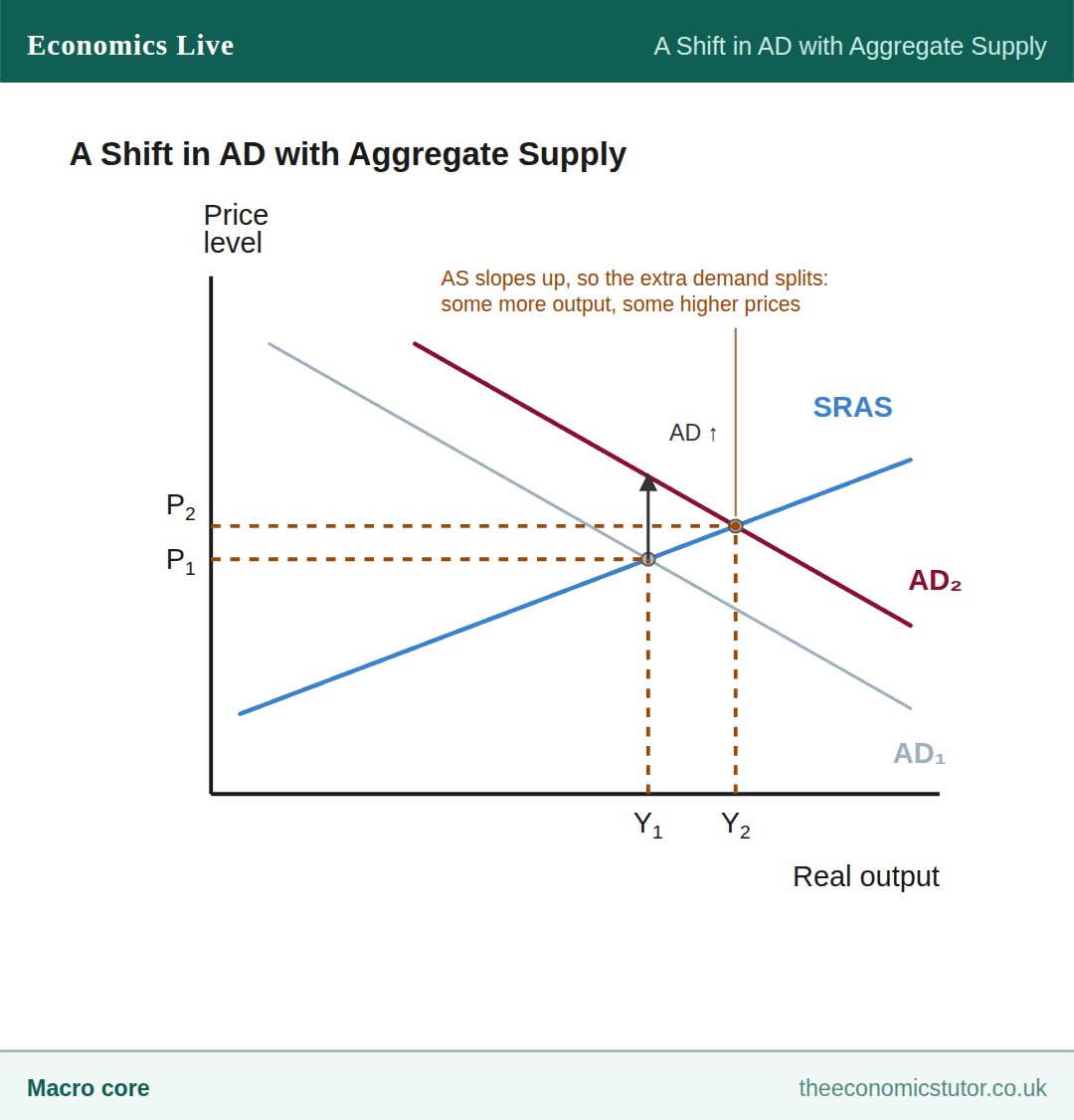
The news: The S&P Global flash UK Composite PMI rose to 53.1 in October 2026, up from 52.0 in September 2026, the strongest growth in private sector activity since February. Any reading above 50 signals expansion compared with the previous month. Services activity rose to 53.1 (from 52.1) and manufacturing output to 53.1 (from 51.5). Firms increased staffing for the first time since September 2024, but input cost inflation was the steepest since June 2026. S&P Global said a Bank of England rate rise was now “a near certainty”.
How to use this in an essay: Use this as evidence in questions on economic growth and monetary policy (9EC0 and 8EC0 Themes 2.3 and 2.6; iGCSE 4EC1 macroeconomic objectives; IAL Unit 2). In a 25-mark question such as “Evaluate whether the Bank of England should raise interest rates”, show AD shifting right: real output rises, but so does the price level. With CPI already above the 2% target, rising AD adds demand-pull pressure, strengthening the case for higher rates.
Evaluation point: However, the PMI is a survey of business sentiment, not official GDP data, and flash figures can be revised. Much of the cost pressure comes from oil, which is cost-push inflation that higher rates do little to fix. Raising rates could cut growth just as hiring recovers.
Source: pmi.spglobal.com